


Why are they doing this to us? It seems like a logical question, but lately it feels more like a rhetorical one. The answers I’ve seen range from frustration over the brute-force reshoring of manufacturing to emotional fears of annexation. While the reactions have been varied, the thing that has bothered me is that there also seems to be a deep discomfort to even ask this question. “What role does Canada play” is not only missing from the discussion but seems to be actively discouraged as treasonous. We see examples of this from both major political parties in Ottawa, with even Liberal House Leader Steven MacKinnon saying that the “blame Canada brigade should sit down”, a clear rebuke that introspection is unwelcome.
While this government preaches that we are blameless victims of an illegal, illegitimate, unjustified, unfair, and unacceptable series of unfortunate tariffs, I wanted to know what Canadians are thinking. So, in our most recent poll I asked, “Which of these reasons do you think is the most important in explaining U.S. behaviour toward Canada?” and provided opportunity to rank the top three motives. What’s interesting is that the results suggest Canadians only half-understand what is happening1.
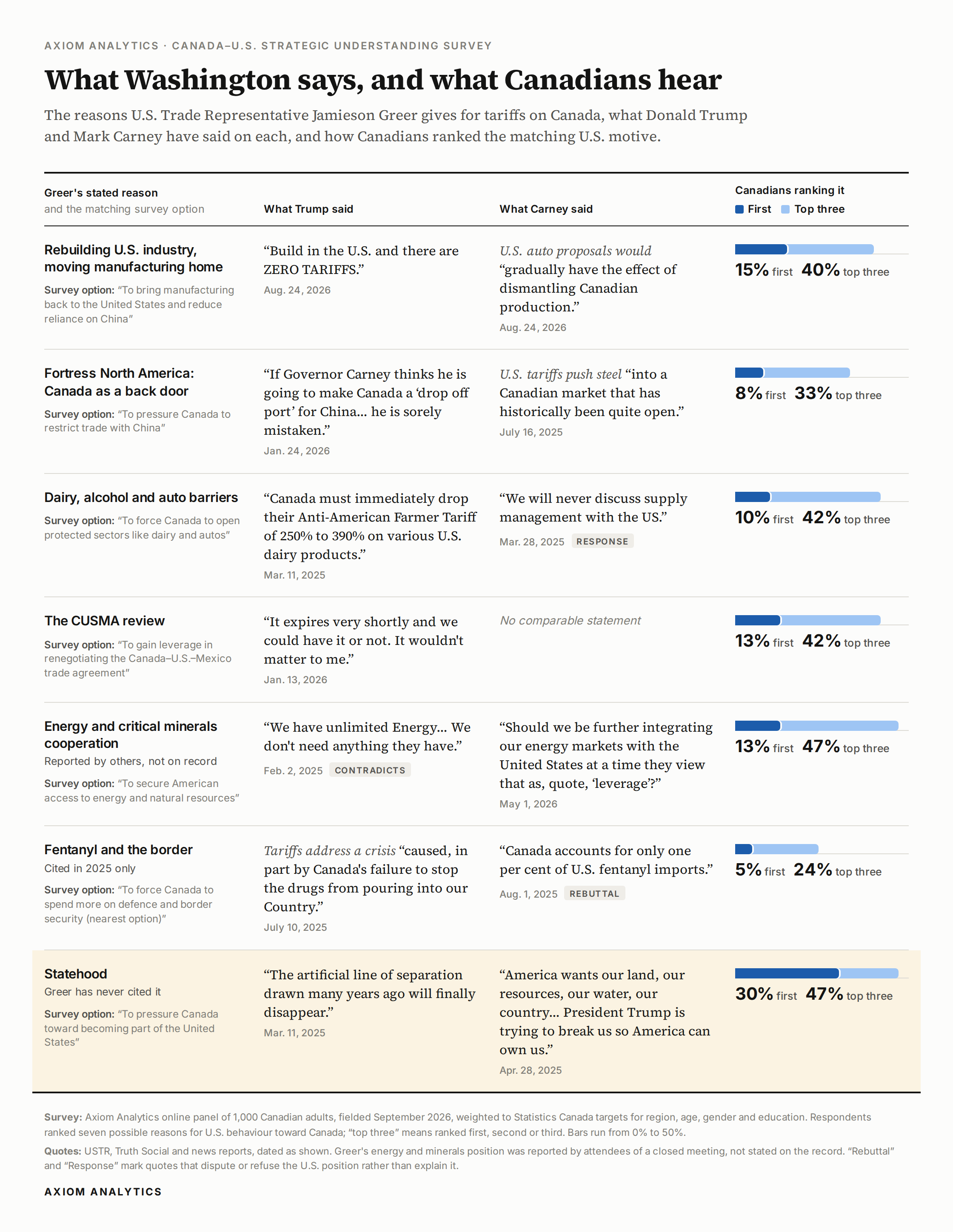
Our data shows that Canadians understand there is an economic motive (58%), but they are far less likely to identify the specific economic concerns being raised by U.S. Trade Representative Jamieson Greer. Instead, statehood dominates the conversation. “To pressure Canada toward becoming part of the United States” is simultaneously chosen as the most important reason for 30% of Canadians and the least important for 22%. To add to the mystery, those who see statehood as the main motive don’t really fit a demographic profile either. Public servants, private sector workers, city and rural residents, graduates and nongraduates all name it as the main motive at about the same rate. So why is that? I would argue the messages from our top leaders are partly to blame.
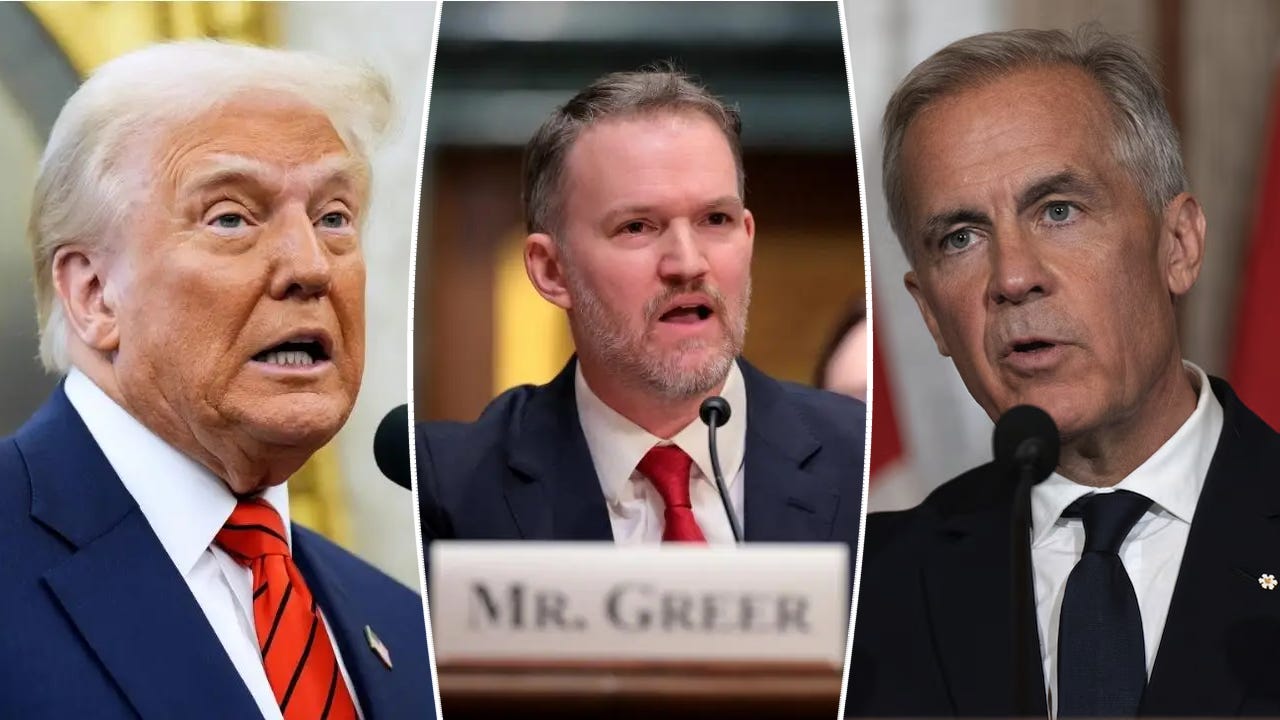
When you look at statements by both the Liberal Prime Minister and the Republican President, both are fuelling the divisive statehood talk in the same bombastic way. President Trump will use statements about Canada becoming the 51st state and Prime Minister Carney tells Canadians that America wants to own us. Compare that with the reasons given by the man actually responsible for trade, Jamieson Greer: rebuilding U.S. manufacturing, stopping Canada from becoming a back door for dumped steel and Chinese goods, and opening protected markets such as dairy, alcohol and autos.
Aside from reshoring, these are among the least-cited motives in our poll, yet the negotiating team is telling us clearly that these items are the priority. Canadians simply aren’t hearing it over the noise of our leaders. What makes matters worse is not just that we’re not hearing the other side, but we’re focusing on reasons they’ve already dismissed. Take energy for example, Trump says that they don’t need Canadian energy, yet 47% of Canadians rank it in their top three reasons for tariffs. To see a breakdown of each of these reasons and how Trump, Greer, Carney and Canadians have responded, you can compare them in the chart below.
So where does that leave us, the Canadian public, reeling over job losses, higher prices, and the lack of a foreseeable deal? We need to demand our leaders listen to the wisdom of the people, and stop reacting to the emotions of a presidential social media post. We’ve already made strides by dropping the digital services tax that was a legislative headache, and there are more opportunities to find mutual wins. The answer isn’t to just give America what it wants. It’s to distinguish between what can be negotiated, what should be negotiated, and what is clearly not up for debate. With that lens in mind, I see four clear paths forward:
1. Close the back door
Align Canada’s tariffs on steel, aluminum, and Chinese goods with the U.S., framed as protecting Canadian industry. 41% of Canadians already see limits on Chinese imports as Canada protecting itself, against only 23% who would see it as following U.S. orders. 52% see a transshipment problem and Carney has already acknowledged that U.S. tariffs are pushing foreign steel into Canada.
2. Put Greer’s named barriers on the table, starting where public resistance is lowest
Only 12% of Canadians say dairy protection should be defended most firmly, making it one of the areas where Canada may have the most room to negotiate. The Montreal Economic Institute estimates supply management costs Canadians $244 per person per year. Repealing Bill C-202 could therefore be framed not as surrendering to Washington, but as making groceries more affordable while addressing one of the barriers on Greer’s list.
3. Build side by side on reshoring manufacturing
48% see U.S. reshoring as an opportunity or a shared goal, so frame it as a partnership, not a concession.
4. Draw the sovereignty line explicitly
Statehood and vetoes over Canada’s trade deals are not up for negotiation. Canadians who feel that this is all about statehood are least willing to negotiate (25%) and the most willing to walk away (41%). We need to remove the frame that a deal is surrender.
None of these paths asks Canada to surrender, and we need to stop labeling those who try to understand Canada’s role in the American argument as traitors. The landscape is loud, but adding to the noise isn’t the way forward. Neither is waiting to see what happens next. We need our leaders to start proposing solutions and get back to the negotiating table with ideas that create mutual wins. Because at the end of the day, the President is going to keep posting, the Prime Minister is going to keep answering, and 73% of us want some form of negotiation. It’s time to get a deal for Canada. That’s what they were elected to do, after all.
Methodology: Axiom Analytics’ Canada–U.S. Strategic Understanding Survey, n=1,000 Canadian adults, fielded in English and French through Logit’s online panel in September 2026. Results are weighted by region, age, gender and education to Statistics Canada targets. Because this is a non-probability online panel, a margin of error does not apply. For comparison, a probability sample of this size would carry a margin of error of ±3.1 percentage points, 19 times out of 20. Differences described as gaps are statistically significant. Groups described as the same or “just as likely” show no significant difference.
👏👏👏