


If you want to understand the profound underlying sickness of the ruling class here in Canada, you only need to look at a single, simple contrast: what they refuse to govern versus what they demand to control.
Every single day, the Ottawa elite look directly into the cameras and read from the same focus-group script. Trust us, they say. Everything is fine. The plan is working. But while they use comfortable, sanitized language to manage your perception of our country’s decline, they are actively bartering away our national sovereignty abroad and quietly assembling an authoritarian digital hellscape here at home.
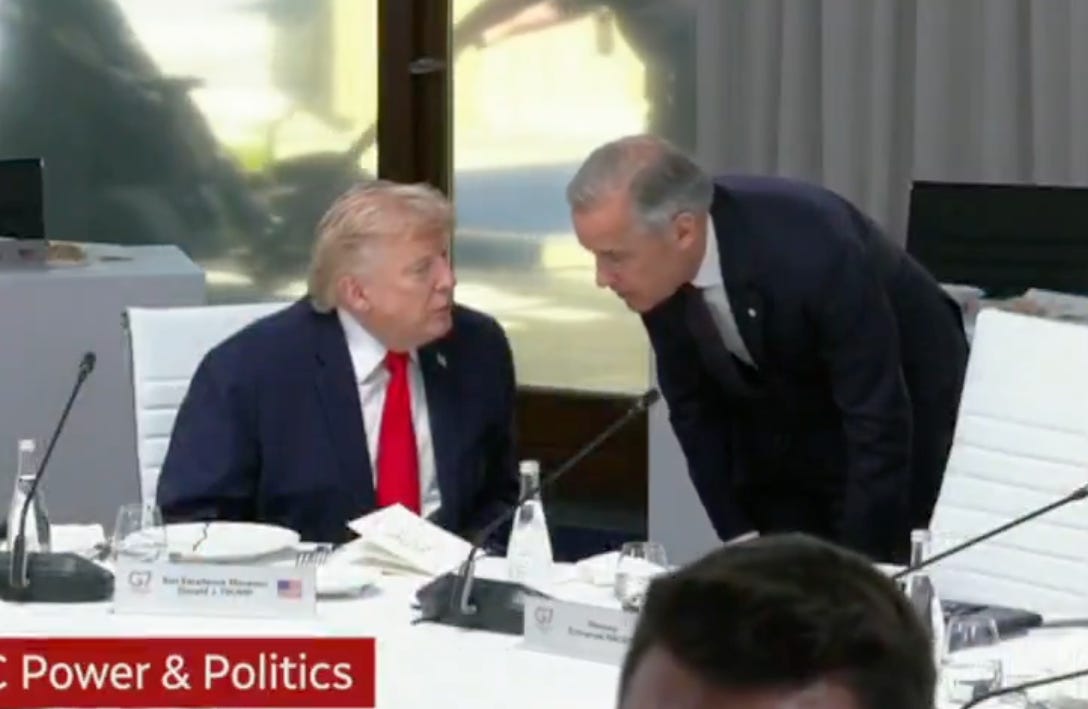
This afternoon, Prime Minister Mark Carney was caught on a hot mic desperately trying to placate U.S. President Donald Trump over Chinese electric vehicles, reducing a massive national security threat to a mere inventory game. Meanwhile, back on Parliament Hill, the Liberals are quietly racing to push through a trio of interconnected bills designed to establish absolute state surveillance over your digital life.
The EV Hot-Mic: Bartering Security for Globalist Favour
Let’s start with the audio that has everyone in Ottawa talking today. Reporters and cameras were briefly allowed into a high-level room, capturing a striking moment where Mark Carney leaned over a chair to whisper assurances directly into Donald Trump’s ear.
Carney’s mission? Reassuring the White House that Canada’s backdoor openness to Chinese-made electric vehicles isn’t a threat to the American perimeter. At. that time, David Cochrane over at the CBC scrambled onto the airwaves to help the PMO spin what occurred, confirming that Carney was bragging about a “hard cap” on Chinese auto imports.
The Ottawa Spin: The PMO wants you to look at the numbers. They are claiming Chinese EVs will be strictly capped at just 3% of the Canadian auto market—amounting to roughly 49,000 cars today, with a projected crawl up to 70,000 over the next five years. Carney literally told Trump, “We figured that you would like that.”
It is a slick, corporate framing technique, and it is a semantic lie. Carney and the state broadcaster are intentionally trying to turn a profound national security threat into a mundane commercial inventory dispute. The piece that was extremely eye opening was Carney honing in on that 3% figure. When in reality bringing in 49k Chinese EVs would take up close to 30% of Canada’s EV market.
Let’s be entirely real about what a modern smart vehicle actually is. It isn’t just steel, glass, and rubber anymore; it is a sophisticated, rolling computer system. A modern EV possesses advanced sensor suites, cameras, and GPS arrays tied to a live, uninterrupted data link.
When you allow 49,000 of these vehicles onto Canadian roads, you are effectively letting an adversarial regime map out your critical infrastructure, track your military installations, and log the movement patterns of your citizens in real-time. If your adversary has the technological architecture to spy inside your borders, it doesn’t matter if the number of vehicles is 10, 10k, or 49k.
By reducing our national security to a trade quota, Mark Carney is proving that Canadian sovereignty is simply a commodity he is willing to barter away piece by piece to maintain favour with globalist institutions.
The worst part? The Americans see right through it. Cochrane admitted himself that there is absolute, zero-bipartisan appetite in Washington for Canada’s Chinese EV loopholes. When Trump eventually drops the hammer on this setup, the Liberals will act shocked and blame “American unpredictability.” But the truth is, Carney is setting us up for an absolute trade disaster.
The Three-Headed Censorship Monster: C-22, C-34, and C-36
Over the past few weeks, the Liberals have introduced three distinct bills: Bill C-22, Bill C-34, and Bill C-36. They are marketing them as separate, unrelated pieces of standard policy. One is branded as protecting children, another as modernizing commercial privacy, and the third as helping police track down digital criminals.
But if you look past the titles and map out the internal mechanics, you realize these aren’t separate bills at all. They are a three-headed regulatory monster designed to cross the finish line together, creating an unprecedented digital regulatory superpower.
Prominent Canadian privacy expert Michael Geist recently sounded a massive alarm on the latest iteration, Bill C-36 (the Protecting Privacy and Consumer Data Bill). Geist exposed that buried deep inside this massive text is a radical, unprecedented shift in how our data is handled. The bill effectively terminates the independent Privacy Commissioner’s decades-long oversight over private-sector privacy law, transferring that immense power to a brand-new, unelected body: the Digital Safety and Data Protection Commission.
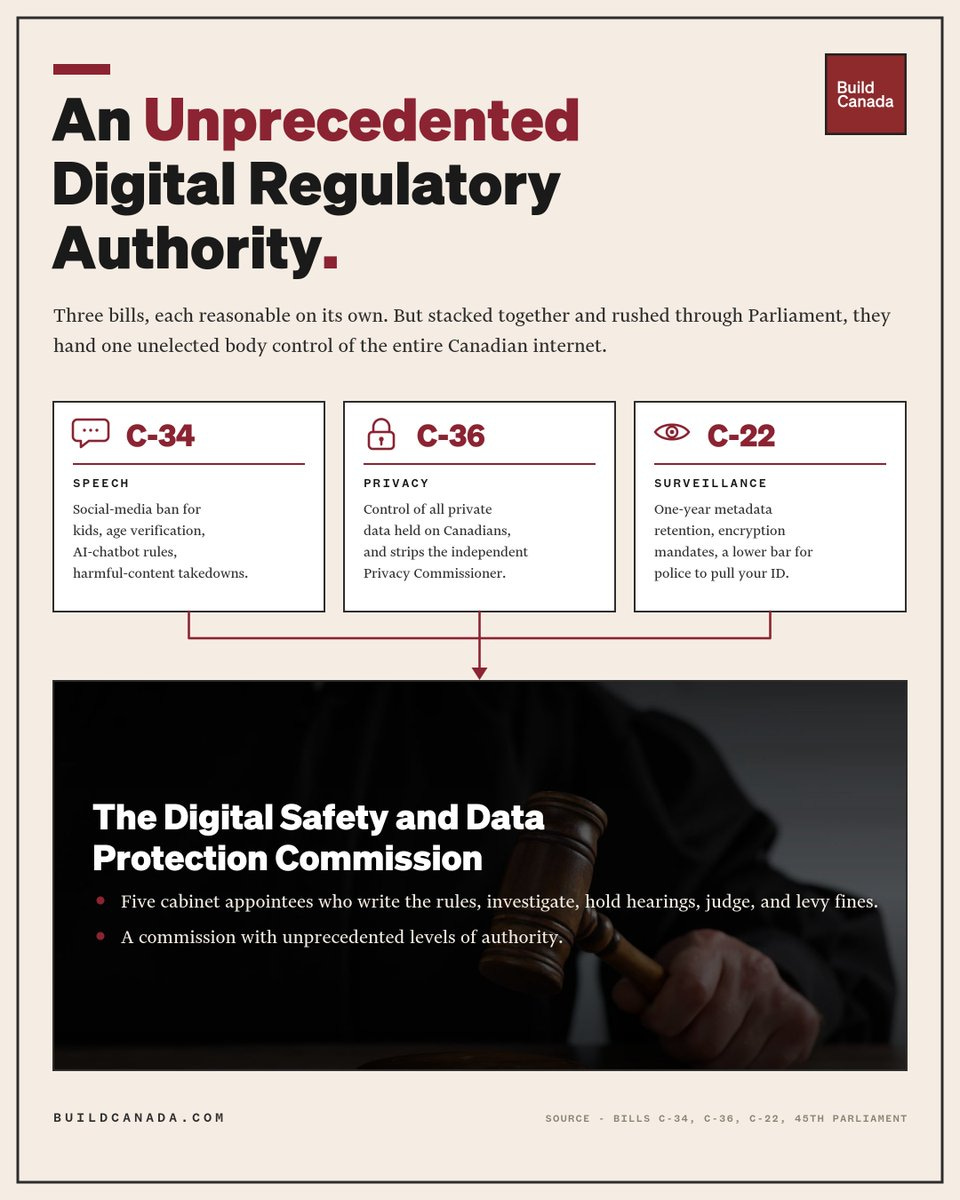
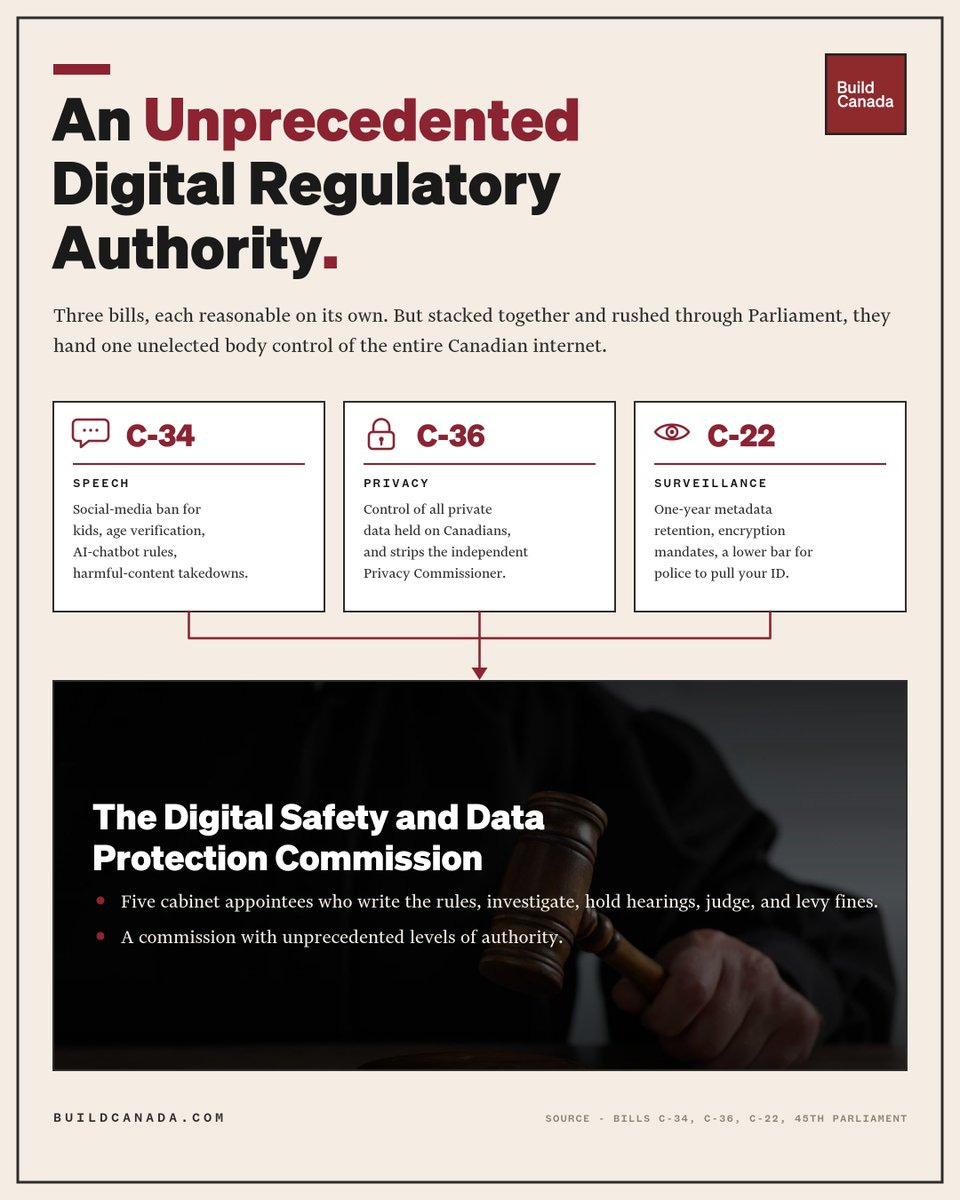
Build Canada put out a brilliant infographic mapping out exactly how these three pieces of legislation converge to build a state surveillance apparatus:
Bill C-34 (The Trojan Horse): Marketed as a clean social media ban for children under the age of 16. But hidden inside the text, the government grants itself the sweeping authority to unilaterally order the removal of any online content they subjectively deem to be “terrorist activity” or “hateful speech.”
Bill C-36 (The Privacy Lock): Strips authority away from independent agents of Parliament and hands full control over all private consumer data held on Canadians to an unelected, five-member political commission.
Bill C-22 (The Surveillance Mandate): Imposes a mandatory one-year retention period on your metadata, forces encryption mandates, and lowers the legal threshold required for law enforcement to seize your digital identity and inspect your private communications.
The Footprints of Bill C-63
To understand how insidious this strategy is, you have to trace these bills back to their true origin story: Bill C-63, the infamous Online Harms Act introduced two years ago in 2024.
Remember what Bill C-63 attempted to do? It was an aggressive, overreaching bill that tried to grant a politically appointed board the power to police your speech, regulate social media algorithms, and structurally imprison citizens based on the mere suspicion that they might commit a hate crime in the future. The public pushback was intense, and the Liberals realized that packing that much authoritarian control into a single bill was a political mistake.
So, what did they do? They chopped the carcass of Bill C-63 into three separate pieces. They spaced out their introductions over the last two months, wrapped them in flowery, emotionally manipulative language about “protecting kids,” and let them glide through the legislative pipeline under the radar.
When these three bills pass, they will all feed directly into the exact same centralized entity: the Digital Safety and Data Protection Commission. This unelected, five-member super-regulator will hold unchecked authority over what you are allowed to say, what stays private, and who the state is allowed to watch.
The Bottom Line
This is the definitive blueprint of modern Ottawa. A government that talks endlessly about “digital safety” while systematically stripping away your privacy rights, and brags about “cooperation” while covering its tracks behind closed doors, isn’t interested in governing.
They want to manage your perception of their decline. They want you to accept a wide-open border, a compromised national security perimeter, and total surveillance inside your own home. But we are equipping this community with the raw facts to push back.
We have compiled the full legislative breakdowns, Geist’s complete analysis, and the Build Canada infographics here in this artcile. Get armed with the data, and start having the hard conversations that change minds.
Watch full episode here:
Carney: ‘The Prime Liar’, aka ‘Crime Minister’