


There are moments in politics where the optics matter just as much as the policy—and sometimes even more. This morning’s developments out of Washington involving Ontario Premier Doug Ford are a textbook example of that reality, and they deserve to be understood not just as a scheduling dispute, but as a signal flare in the broader Canada–U.S. political relationship.
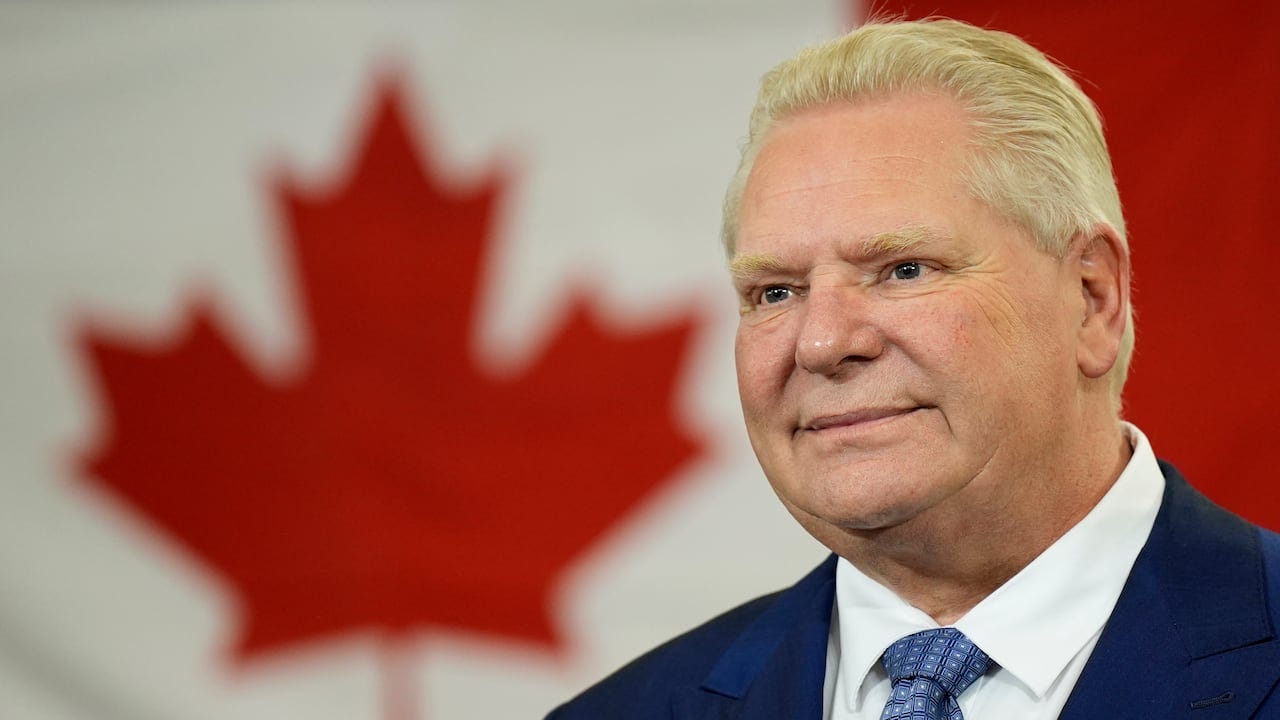
According to reporting from The Globe and Mail, a planned US Chamber of Commerce reception in Washington featuring Doug Ford was abruptly cancelled after White House officials allegedly voiced complaints about the Ontario Premier’s participation. The event—reportedly scheduled as part of Ford’s high-profile visit to the U.S. capital—was intended to include Ross Perot Jr., chair of the Chamber’s board, and serve as a key networking moment with American business leadership.
On paper, the cancellation was attributed to “scheduling conflicts.” But multiple unnamed sources familiar with the situation told reporters a different story: that concerns had been communicated from the White House to business figures in Washington ahead of the event, and that Ford himself was viewed as politically problematic within the Trump administration’s orbit.
Neither Ford’s office, the US Chamber of Commerce, nor Ross Perot Jr. responded publicly in detail, and the White House has not formally confirmed any involvement in the decision. That silence leaves room for interpretation—but in politics, silence often speaks just as loudly as statements.
And that’s where the real question emerges: what exactly triggered this level of friction?
From the perspective of Ford’s critics—and increasingly, from segments of the American political ecosystem—the Ontario Premier has spent the past year oscillating between economic diplomacy and hard-edged political rhetoric toward the United States. At various points, Ford has floated aggressive countermeasures in response to trade tensions, including remarks about energy exports and alcohol product removals during earlier disputes. While those statements were made in a different political context, they continue to circulate in Washington’s institutional memory.
Whether or not those past remarks directly influenced the White House’s reported discomfort, the perception matters. In international politics, consistency is currency—and inconsistency gets priced in quickly.
Ford’s recent media strategy in the United States has also been a balancing act. On one hand, he has emphasized Ontario’s role in North American energy and critical minerals supply chains, pitching what he calls a “Fortress North America” approach to compete with China and stabilize investment flows. On the other hand, his messaging has sometimes been interpreted as reactive rather than strategic, particularly when addressing trade uncertainty and tariff risk.
In a recent U.S. media appearance, Ford argued that deeper integration between Canada, the U.S., and Mexico could strengthen economic resilience, increase investment certainty, and stabilize supply chains. Those claims are not controversial in isolation—but they exist alongside a broader political narrative in which Canada’s leadership has frequently criticized U.S. policy decisions in ways that complicate bilateral messaging.
And that tension is the backdrop to this week’s cancellation.
If the White House did in fact raise concerns about Ford’s presence at a Chamber of Commerce event, it would signal something larger than a personal dispute. It would suggest that Canada’s internal political messaging—particularly from high-profile provincial and federal figures—is beginning to bleed into its diplomatic and business access channels in Washington.
That is not a trivial development.
Because regardless of how one interprets Ford’s political choices, the United States is still Canada’s single largest trade partner by a wide margin. Access to American business forums, policy-adjacent institutions like the Chamber of Commerce, and informal diplomatic spaces is a core component of how Canadian leaders influence cross-border outcomes. Losing or even temporarily losing that access carries consequences far beyond symbolism.
At the same time, it would be too simplistic to reduce this moment to a single cause-and-effect narrative. U.S. domestic politics is volatile, deeply factional, and highly sensitive to perceived foreign interference or criticism. A provincial premier walking into Washington during an election-aligned political climate—while tensions over trade, energy, and China policy remain unresolved—is inevitably going to be interpreted through multiple lenses at once.
And that brings us to the broader Canadian context.
Over the past year, Canada’s political class has leaned heavily into framing U.S. trade pressure and geopolitical competition in increasingly adversarial terms. Whether that is driven by electoral strategy, economic necessity, or public sentiment, it has created a messaging environment where diplomacy and political positioning often collide.
Critics argue this approach has led to unnecessary volatility. Supporters argue it reflects real external pressure and the need to protect Canadian interests. But either way, the outcome is the same: Canada’s relationship with its largest trading partner is now being managed not just in negotiation rooms, but in public political discourse.
That makes events like Ford’s cancelled reception more than just administrative footnotes. They become indicators of tone, trust, and political temperature.
And trust, once strained, is not easily rebuilt.
The irony here is that both sides of this equation claim to be pursuing stability. Ford has repeatedly emphasized investment certainty and integrated North American supply chains. American business leaders have consistently signaled interest in predictable cross-border policy environments. Yet the political signalling on both sides continues to introduce friction into precisely the system both claim to want to stabilize.
The reality is that this broader signal is hard to ignore: Canada’s internal political narratives are increasingly being noticed—and in some cases, resisted—at the highest levels of U.S. institutional engagement.
And that raises the real strategic question going forward.
Is Canada’s current approach to U.S. relations producing leverage—or producing friction that limits access to the very rooms where decisions get made? I think we know the answer to it.
Watch this morning’s full episode for more: