


So one thing that’s really stuck with me since former CBC producer Rodney Palmer's revealing testimony at the Allison Inquiry, was his caution that emotionally charged words are being used to shape how people think and act. He proceeded to list off a couple words that the mainstream media used over and over again, as a way to persuade the population of a certain point, and it made me wonder: what words are we hearing today that are shaping our beliefs? And right on cue, the mainstream media served up the word “sovereignty” and I knew I had found my dog-whistle.
Since January 1, “sovereignty” has appeared in more than 2,700 stories across the Toronto Star, the Globe and Mail, and CBC News according to the analytics platform Media Cloud. That equates to roughly 10 stories a day. Then, when you include “threat” and “sovereignty” together, you’re looking at approximately 2.5 stories daily. Think about that for a moment: every day you are being bombarded with at least two and half stories pushing you to feel that your sovereignty is under threat.
But with all this coverage, do we really know what this word means? Would we know if it were gone?
To start to answer these questions, we asked a representative sample of 1000 Canadians what sovereignty means to them, and 26% of people told us the word either has no specific meaning to them, or that they weren’t sure. You might assume these are just people who aren’t paying attention, and you’d be wrong. Canadians with no definition of sovereignty are just as likely to say our economy is under threat, and just as likely to believe the damage is permanent. You might think, “I know that's an alarming percentage, but at least the remaining 74% broadly agree on what sovereignty means”, and you’d be wrong again.
To some Canadians, sovereignty is being defined in terms of our economic dependence on the United States, to others it’s the fear of annexation. For some it’s the fear of our laws bending under American pressure, and for others it’s our culture being absorbed. There’s no clear consensus. And it’s not just different definitions, this is a completely different read on the situation and what should be done about it. So when a Canadian leader steps up to the podium and tells you about “sovereignty” in a “dangerous and divided world” the country hears four different speeches, and a quarter of it hears nothing at all. We aren’t one country rallying behind one word, we’re four countries and a silence, all shouting the same syllables.
What’s even more interesting is this additional finding from our research: party affiliation, region, and language make no meaningful difference to how people define sovereignty. This isn’t a left vs right problem, this is a cross cutting Canadian problem. It’s the result of an emotion we’re being asked to feel thousands of times over, at a rate of 2.5 stories a day, without any collective agreement about what the word actually means.
That brings us back to a key question about what we are hearing every day: is our sovereignty under threat and what does that mean?
When we look back at how the folks who couldn’t point to a description of sovereignty answer questions about “threats” in the context of the trade dispute with Washington, there is another unique finding. This group is the most likely in our survey to reject any deal with the United States (42% against 30% by other respondents), and the least likely to want to push back (5% against 16%). It is a strange paradox: concede nothing, but fight for nothing. What it shows us, is what it looks like when a country knows it’s angry but doesn’t know what it’s protecting.
The theme right now in the mainstream media is that we need to protect ourselves from the war waged on our economy by our neighbours to the south. What’s curious is that for all the talk of defending ourselves against Washington, some of the most expensive barriers impeding our economy and free trade were made right here at home. Deloitte estimates that removing Canada’s interprovincial trade barriers could add $881 billion to the economy by 2040 and create 133,000 jobs. And if sovereignty truly means having control over our collective economic future, why are we still putting barriers between ourselves? Wouldn’t it stand to reason that before we blame someone else for all our economic woes, we should probably look inward and make sure we are actually doing all that we can for ourselves?
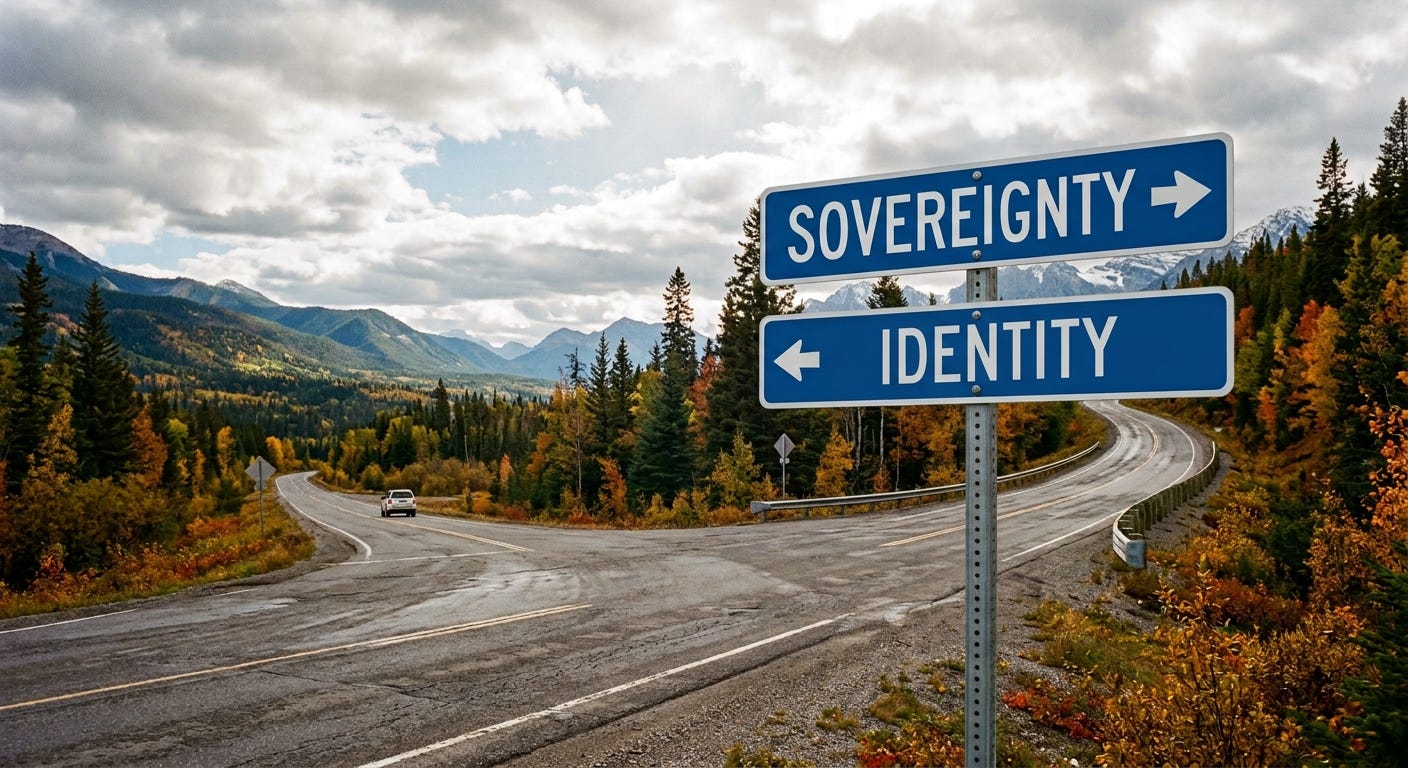
When we get down to brass tacks, sovereignty is ultimately about the authority of a people to determine their own future. But before we decide what that future looks like, we need to have a sense of who “we” are. This is where the deeper problem lies. The word “sovereignty” is being used as though it represents a shared understanding of what we are trying to protect, when our research shows it doesn’t. It instead becomes an emotional trigger, where the fear it invokes can grant the political capital to make decisions unencumbered by consultation. It paints debate as devision, and opposition as treason, like a silver bullet for national unity under a shared anxiety.
I believe that the true remedy to this confusion is to name the distraction and get to the real work of defining who we are. If we as a people are to come together, we must believe that we are working towards a future with shared values and common goals. This is where the real work begins, and I would argue that the longer we are unable to articulate the uniqueness of who we are, the closer we get to being divided and conquered by any external force.
So before we get angry or fearful about sovereignty, let’s ask the question we’ve skipped entirely: what does it mean to be Canadian? It’s the most important question this country has avoided in a generation. Answer that, and sovereignty stops being a word we use to score political points. It becomes the measure of who we are, and whether we’re still writing our own story.
No one has taken the pen from us, so let’s write a definition worth defending.
Methodology: Axiom Analytics’ Canada–U.S. Strategic Understanding Survey, n=1,000 Canadian adults, fielded in English and French through Logit’s online panel in September 2026. Results are weighted by region, age, gender and education to Statistics Canada targets. Because this is a non-probability online panel, a margin of error does not apply. For comparison, a probability sample of this size would carry a margin of error of ±3.1 percentage points, 19 times out of 20. Differences described as gaps are statistically significant. Groups described as the same or “just as likely” show no significant difference.