


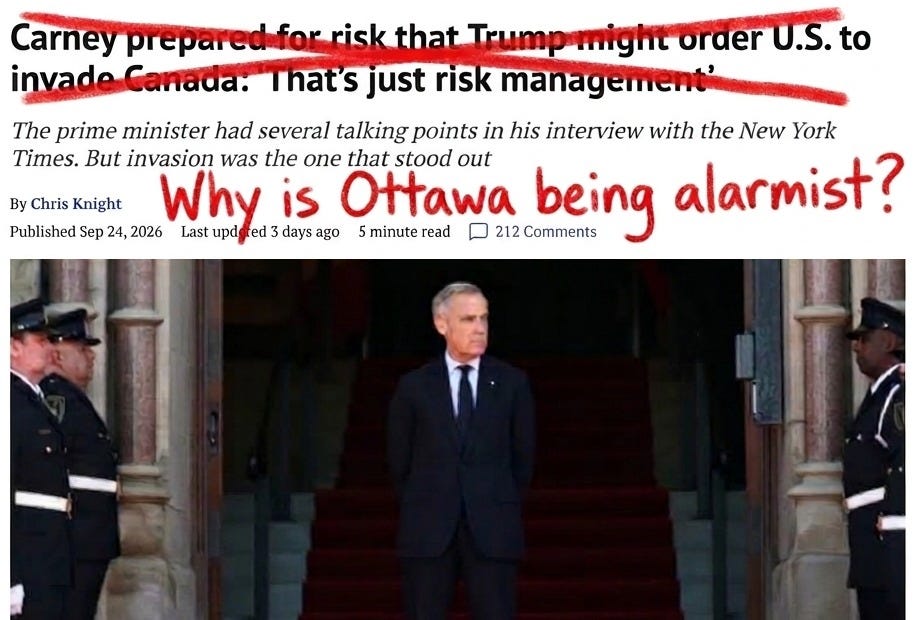
It can feel overwhelming and daunting to imagine what role we as individuals play in an economic conflict between two nations. We don't set the tariffs, negotiate the trade agreements, or decide how Washington or Ottawa responds. But this is where I draw attention to the very real power that we as a collective have. We have influence over something arguably just as important: how we understand what is happening. Ottawa depends on public support to exercise power, and the stories we believe about a threat help determine how much power we are willing to give them in response. That makes the narrative surrounding this trade dispute more than just commentary, it becomes part of the conflict itself.
As a researcher and trained evaluator one of the mantras I live by is: “no stories without numbers, no numbers without stories”. Right now I think Canadians are hearing a story that needs to be tested against the numbers. The story we are hearing is of a country at war, threatened by a neighbour hell-bent on destroying some of our most vital sectors. This is where the data diverges from what we are hearing, and instead I want to tell you the more complicated story from our latest poll of 1000 Canadians.1
In our poll we asked, how personally affected people were by the dispute, and if they perceived the United States as a threat. We then compared those responses with employment status and stated occupation. The result was striking.
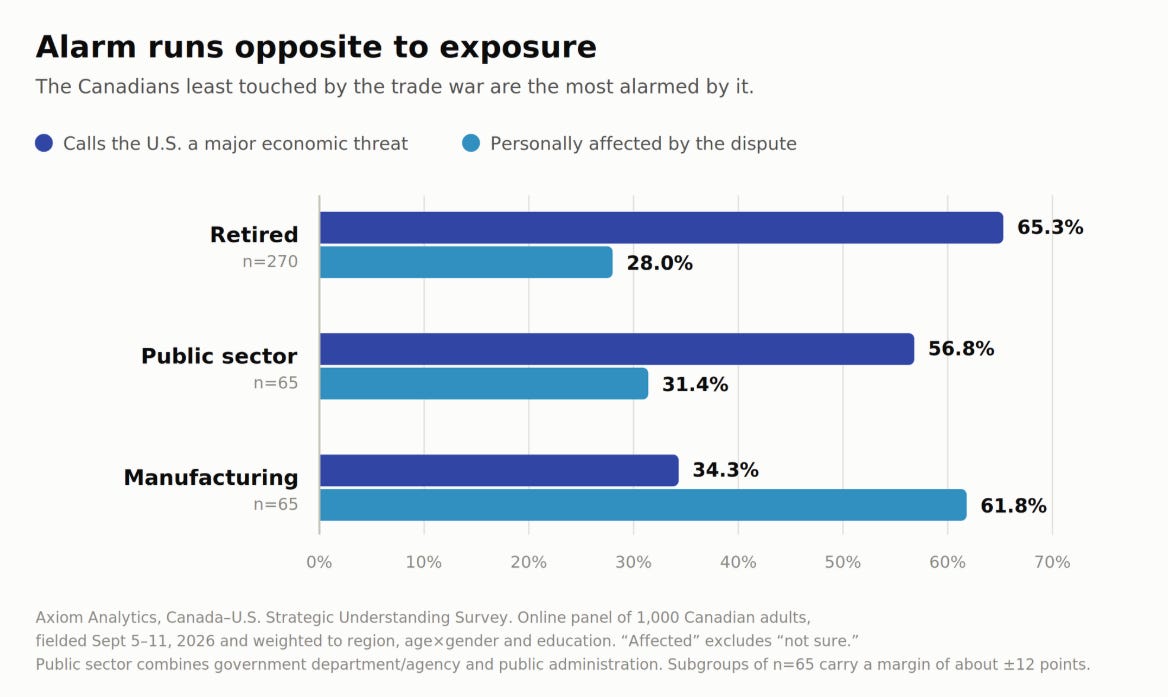
Canadians who rated themselves least affected by the trade dispute were also the most likely to see the United States as an economic threat.
Who are these individuals? Retirees and Public Sector workers. Now comes the really interesting part:
Manufacturers were the least likely to rate the United States as an economic threat.
That finding raises an uncomfortable question: Why are the people who are the most exposed to the economic consequences of the dispute less likely to describe the United States as a threat than those who are not directly affected?
My theory is that there is a difference between experiencing a trade dispute and experiencing the narrative surrounding it. This is not the first time that Canada and the United States have argued over trade and tariffs. Those actively involved in the business of trade may be more likely to see what’s happening through the lens of two countries with competing economic interests, each trying to secure the best possible deal. Those farther removed might instead be experiencing this dispute only through political commentary and emotionally charged headlines from legacy media outlets.
And we are seeing examples of this constantly. Last week, Canadian media coverage of a New York Times interview with Mark Carney was dominated by the headline: “Canada prepares for possibility of military invasion by US.” What this does is raise the fear and anxiety of an entire nation to think that we might be in physical danger and inevitably changes the tone and temperature of the conversation. Which I would add is incredibly unhelpful when trying to reach a deal on a complicated economic negotiation.
So how should we approach this, if those who are most impacted are saying that this is not a threat, and those who are least affected feel that it is? Our polling offers an answer.
When we asked what approach Canada should take in the next stage of negotiations, direct engagement and negotiation or to retaliate and confront the administration, 34% of respondents picked the diplomatic option and only 13% thought we should retaliate. Among the remaining respondents 39% still supported an approach that included negotiation alongside confrontation. Taken together that means 73% of respondents believe a diplomatic approach needs to be included in how we respond.
The problem arises when we asked regardless of perspective, what approach people believed Ottawa is currently taking, the results were all over the map, with no consensus on what the federal government is actually doing. That’s no small disconnect. We might disagree on how confrontational we should be, but the evidence is clear that diplomacy is the preferred approach, which the rhetoric misses entirely.
This is not new wisdom unlocked by the power of public polling, this is something we’ve always known as Canadians. I was taught “you catch more flies with honey than vinegar”, and right now it feels like we’ve collectively drank the vinegar. The bitterness towards our neighbours is something like I’ve never seen before, and I worry that we are allowing the rhetoric to become more damaging than the dispute itself.
We need to remember, regardless of your feelings towards Trump and the American administration, we are not at war. We are in a trade dispute, and that distinction matters. Because when we convince ourselves that we are at war, we begin to behave as though everything is an existential threat. Every disagreement becomes an attack, every concession becomes surrender, and every attempt at cooperation becomes weakness.
Instead of only asking “why are we being attacked”, we need to also ask why it is that those who are most affected are not seeing it this way? Who benefits by keeping an entire country in a state of collective anxiety? What liberties are being sacrificed at the altar of safety? And how do we truly give ourselves more than what can be taken away, not only economically, but ideologically at our core. That is a conversation we aren’t having while our country is stuck in fight-or-flight.
Let’s collectively take a breath, we are not at war, we’ve been down this road before, and we’re not confused about how to act. Regardless of political leaning, we need to demand that our leaders and the apparatuses that support them, be transparent about what they are actually accomplishing. We should expect negotiation where negotiation can work. We should defend Canadian interests without pretending every disagreement is a fight for sovereignty. We must end the language of war long enough to have a conversation that returns to the spirit of collaboration we’ve always had.
Methodology: Axiom Analytics’ Canada–U.S. Strategic Understanding Survey, n=1,000 Canadian adults, fielded in English and French through Logit’s online panel in September 2026. Results are weighted by region, age, gender and education to Statistics Canada targets. Because this is a non-probability online panel, a margin of error does not apply. For comparison, a probability sample of this size would carry a margin of error of ±3.1 percentage points, 19 times out of 20. Differences described as gaps are statistically significant. Groups described as the same or “just as likely” show no significant difference.
ia800705.us.archive.org
“All wars are bankers’ wars”.
Josh…. As per global events, you are missing the biggest piece of the puzzle, and it is right in front of us all. It is no accident that a central bankster was parachuted into the PMO of Canada!!
We need to have a chat about what is REALLY going on in Canada, and this world.
Reach out please 👍
grantb9348gmail.com